The world's first trillionaire, and why there shouldn't be one
By Cozzy · Published June 2026 · Last reviewed June 2026 · Sources verified against primary references as of June 2026.
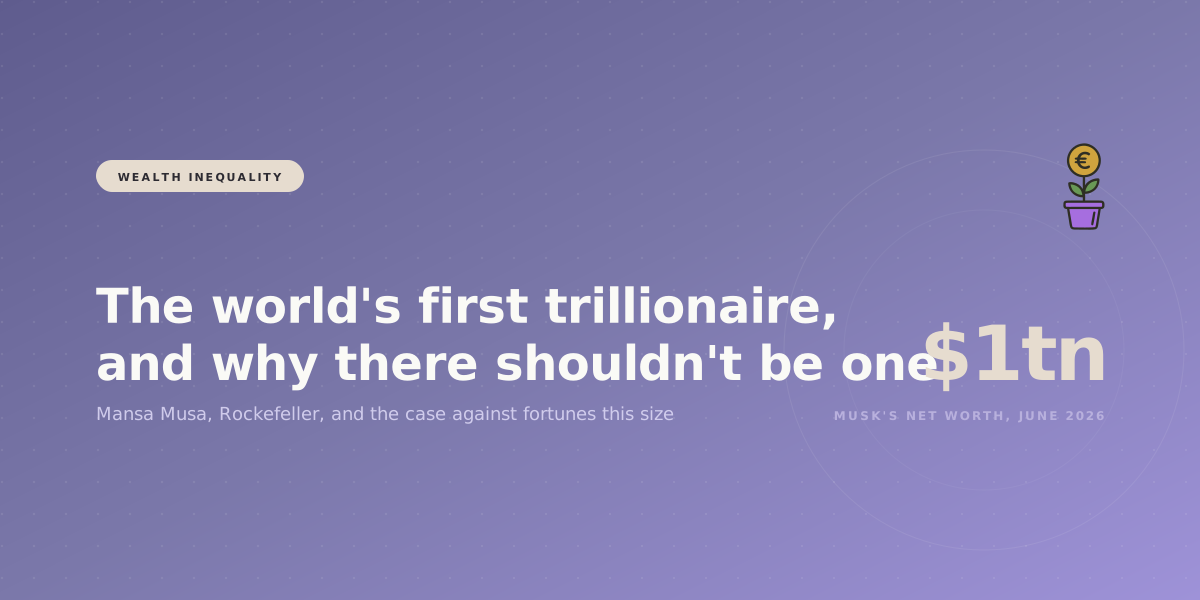
On the 12th of June 2026, Elon Musk became the world's first trillionaire (Al Jazeera, 2026).
SpaceX began trading on the Nasdaq at $135 a share, valuing the company at $1.77 trillion after a historic IPO. Elon Musk owns about 42% of SpaceX.
One trillion; a number so large it's hard to feel anything about it. A billion already sounds like a trillion to most of us. But we think this milestone deserves more than a shrug, because the evidence points to an uncomfortable conclusion: wealth at this scale is bad for everyone else, and history has been here before.
That's a strong claim, so let's earn it. First the scale, then the history, then the research. And because the case for the ultra-rich is made by serious economists, we'll give it a fair hearing too.
How much money is a trillion dollars?
A trillion is a thousand billions. That definition doesn't help much, so here are some comparisons that do.
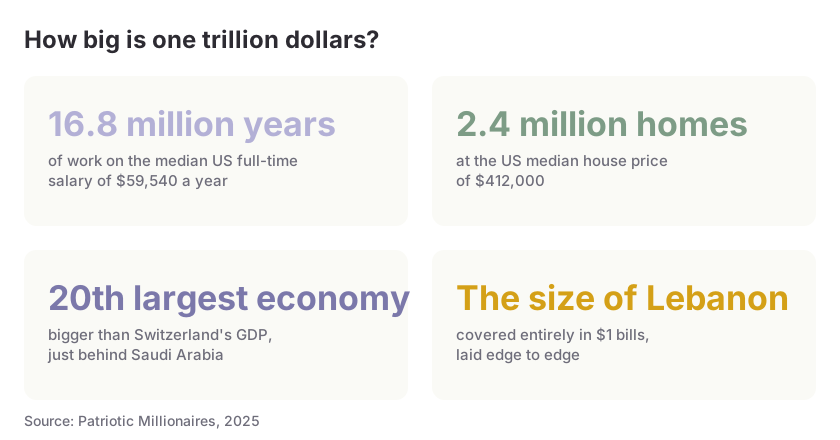
A median full-time American worker, earning $59,540 a year, would need to work 16,795,432 years to earn $1 trillion (Patriotic Millionaires, 2025). That's longer than our species has existed.
The same analysis found that $1 trillion:
- Could buy roughly 2.4 million homes at the US median price of $412,000.
- Laid out in $1 bills, would cover an area about the size of Lebanon.
- Would rank as the 20th largest economy in the world, ahead of Switzerland's GDP.
One caveat: this is not cash in a vault. Musk's fortune is almost entirely shares in companies he runs, and Daniel Waldenström of Sweden's Research Institute of Industrial Economics points out that this kind of wealth is not "carved in stone" (Al Jazeera, 2026). A trillionaire on paper can be worth far less a year later. That softens the number. As we'll see, it doesn't soften the problem.
Has anyone in history been this rich?
Probably not, though comparing wealth across centuries is genuinely hard.
"Elon Musk might be the wealthiest person who has ever lived."
— Guido Alfani, professor of economic history at Bocconi University, excluding rulers whose personal wealth blended with state assets (Al Jazeera, 2026)
The usual contenders for "richest ever" show what extreme wealth does to the world around it.
Mansa Musa, ruler of the Mali Empire from 1312 to 1337, controlled gold and salt trades at a time when Mali produced a large share of the world's gold (Britannica). His fortune is often estimated at around $400 billion in today's money, though historians stress that figure is closer to a guess than a measurement (Celebrity Net Worth). On his 1324 pilgrimage to Mecca, he gave away and spent so much gold passing through Cairo that contemporary accounts say he noticeably moved the value of gold in Egypt (Britannica). One person's spending shifted a region's prices. That's the core problem with wealth at this scale, visible seven centuries ago: it stops being personal money and starts being everyone's economy.
John D. Rockefeller is usually named the richest American in history. His fortune reached about $1.4 billion by 1937, roughly 1.5% of US GDP at the time (Yahoo Finance, 2024). Adjusted for pure inflation that's only about $24 billion in 2018 dollars (Wikipedia); what made him a giant was the slice of his economy he owned.
Until now. Musk's wealth passed 1.6% of US GDP in late 2024, edging past Rockefeller's peak share (Yahoo Finance, 2024), and the SpaceX listing has pushed it further.
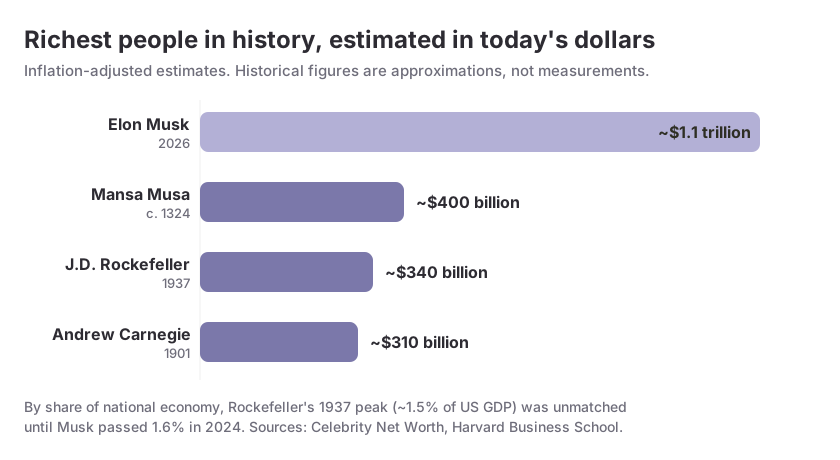
So on the measure historians consider most meaningful, the share of the economy one person holds, we are in genuinely new territory.
Why shouldn't anyone hold this much wealth?
The case rests on three findings, and none of them depends on what you think of any individual billionaire.
First, concentrated wealth becomes concentrated power. Oxfam's January 2026 report found billionaires are an estimated 4,000 times more likely to hold political office than ordinary citizens, and that half of the world's largest media companies are billionaire-owned (Oxfam International, 2026).
"Wealth is power. An extreme concentration of wealth means an extreme concentration of power."
— Gabriel Zucman, professor of economics, Paris School of Economics (Berkeley Talks, 2025)
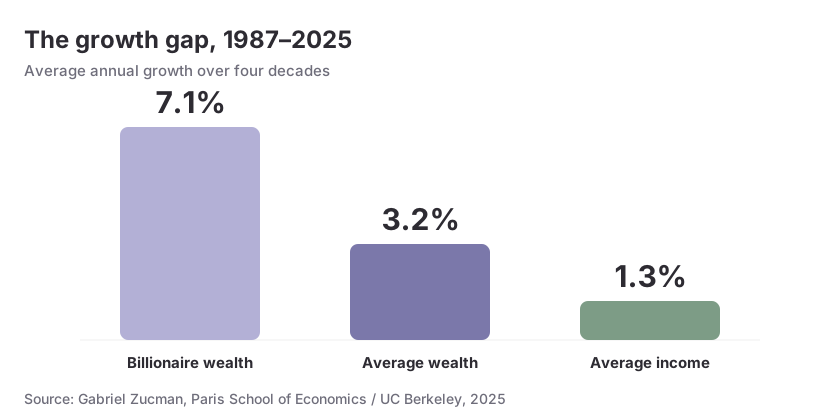
Second, the gap compounds, by design. Zucman's research finds billionaire wealth has grown 7.1% a year over four decades, against 3.2% for average global wealth and 1.3% for average income, while billionaires pay only about 0.2% of their wealth in tax each year (Berkeley Talks, 2025). Money that grows at 7% and is taxed at 0.2% doesn't stop at one trillion. The first trillionaire is a waypoint, not a peak. Oxfam's data shows the acceleration: billionaire wealth grew 16% in 2025 alone, to a record $18.3 trillion, and is up 81% since 2020 (Oxfam International, 2026).
Third, the opportunity cost is staggering. The Brookings Institution has calculated that about $95 billion would be enough to lift all 708 million people then living below the $1.90-a-day line out of extreme poverty for a year (Brookings). That's less than a tenth of one trillionaire's paper fortune. Selling that much stock at once is impossible without crashing its price, so the comparison is imperfect. But it shows what's now parked in single pairs of hands.
"The widening gap between the rich and the rest is at the same time creating a political deficit that is highly dangerous."
— Amitabh Behar, Executive Director, Oxfam International (Oxfam press release, January 2026)
What's the case for the ultra-rich?
It deserves a fair hearing, because serious economists make it.
"Billionaire innovators create enormous value for society."
— Michael R. Strain, Director of Economic Policy Studies, American Enterprise Institute (AEI)
Strain's argument leans on a 2004 paper by Nobel laureate William Nordhaus, which found that "only a minuscule fraction", about 2.2%, "of the social returns from technological advances" goes to the innovators themselves (AEI). The other ~98% flows to the rest of us as lower prices and better products. On this view, a giant fortune is a small commission on a much larger public benefit.
That's the strongest version of the case, and it's worth taking seriously: reusable rockets and cheaper electric cars are real. But notice what it defends. It justifies people getting rich by building things. It doesn't justify fortunes that then compound untaxed at 7% a year forever, decades after the innovation happened. You can keep the incentive to build without keeping the permanent, self-growing concentration of power. Zucman's proposal, a global minimum tax of 2% on billionaire wealth, would raise about $250 billion a year while still leaving those fortunes growing at roughly 5% annually (Berkeley Talks, 2025). Critics like Waldenström warn that taxing paper wealth is harder than it sounds and can push capital abroad (Al Jazeera, 2026). That's a real implementation problem. It's not an argument that trillionaires are fine.
Doesn't philanthropy solve this?
Some of the richest people alive agree the system has gone too far, and they're acting on it.
"I recognize the absurdity of so much wealth being concentrated in the hands of one person, and I believe the only responsible thing to do with a fortune this size is give it away."
— Melinda French Gates, co-founder of the Giving Pledge (Giving Pledge letter)
MacKenzie Scott has given away $26.3 billion since 2019, including $7.1 billion in 2025 alone, mostly as unrestricted grants to working charities (CNBC, 2025). Her single year of giving exceeded what most billionaires donate in a lifetime (Fortune, 2026).
But here's the problem: the givers are the exception. The Institute for Policy Studies tracked the original signatories of the 2010 Giving Pledge, who promised to give away at least half their wealth. The 32 who are still billionaires have grown 283% wealthier since signing; their wealth has compounded faster than they've given it away (Institute for Policy Studies). The IPS verdict: "At this rate, the Giving Pledge appears to be mostly an empty promise."
"Charitable contributions simply aren't keeping up with what could be raised from a fairer tax code."
— Chuck Collins and Bella DeVaan, Institute for Policy Studies (IPS)
Voluntary giving, in other words, depends entirely on who the rich person happens to be. Scott and French Gates chose to give. Most don't, and at 7% compound growth, fortunes outrun even genuine generosity. A system that only works when individuals volunteer to dismantle their own position isn't a system. It's luck.
What did the last Gilded Age teach us?
The closest historical parallel is America around 1900, when Rockefeller and Carnegie held their peak shares of the economy. Joshua Rosenbloom, an economics professor at Iowa State University, notes that back then "the rise of large concentrations of wealth was politically controversial" too (Al Jazeera, 2026). That era didn't resolve itself through philanthropy. It ended with antitrust laws, the breakup of Standard Oil, and progressive income taxes.
Even the Gilded Age's own winners saw the problem. Andrew Carnegie, in his 1889 essay The Gospel of Wealth, wrote:
"The man who dies thus rich dies disgraced."
— Andrew Carnegie, The Gospel of Wealth, 1889 (Carnegie Corporation)
Carnegie went on to give away some $350 million, nearly 90% of his fortune, with much of it funding public libraries (History). And yet a century later, Zucman finds the 19 richest American households hold 1.8% of total US wealth, more than double the 0.8% held by the equivalent group in Carnegie's day (Berkeley Talks, 2025). Individual conscience, even Carnegie-sized conscience, didn't stop the concentration. Rules did, for a while, and then the rules eroded.
The lesson: wealth past a certain scale is a structural problem, not a personal one. The first trillionaire is this generation's version of the question.
What can you do about any of this?
You can't control global wealth concentration. But the story holds practical lessons for your own money:
- Compounding is the whole game. Billionaire wealth grew 7.1% a year for forty years, mostly through owning assets, not earning wages. The same mechanism, at any scale, is how ordinary savings grow.
- Paper wealth isn't spendable wealth. Even a trillionaire's fortune is mostly valuations, not cash. Your net worth deserves the same honest reading: what's liquid, what's not.
- Watch shares, not just amounts. Historians compare Rockefeller and Musk by share of the economy, not raw dollars. Your own finances work the same way: what % of income you save matters more than the euro figure.
- Know where you actually stand. Most of us track the world's richest more closely than our own balance sheet.
Cozzy helps you see your own full financial picture clearly: what's coming in, what's going out, and what you actually own. Get clarity on your money.