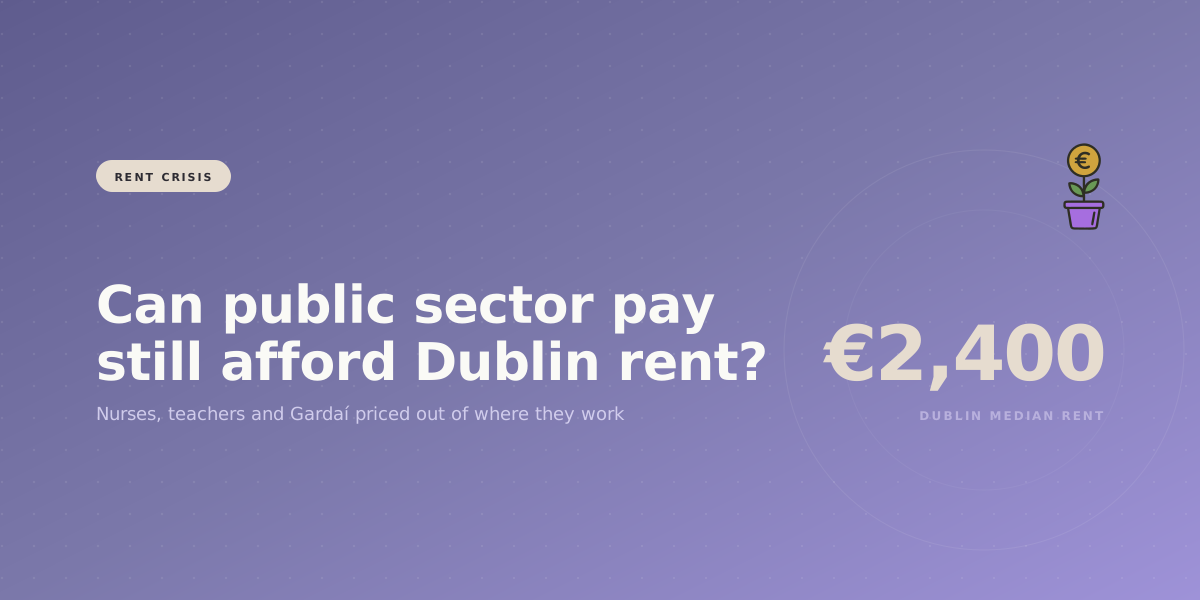
Ireland's Rent Crisis: Can Public Sector Workers Still Afford to Live Where They Work?
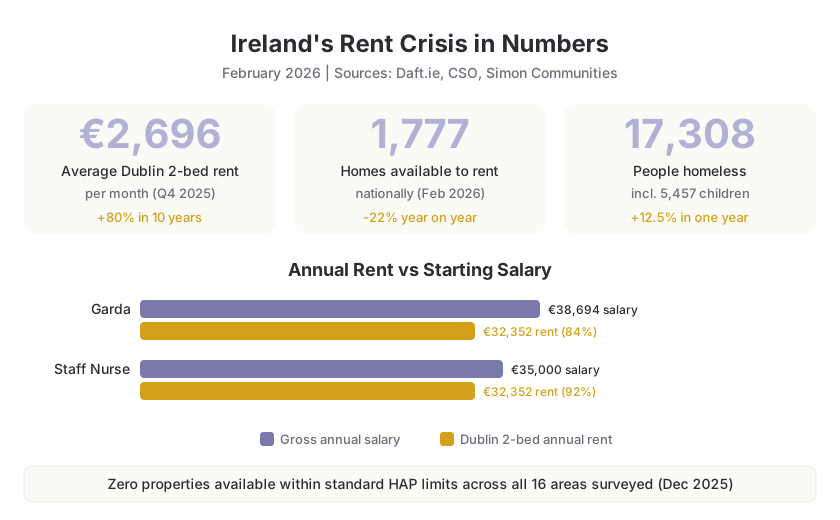
A newly qualified Garda earns €38,694 a year. A two-bedroom apartment in Dublin costs €2,696 a month. That's €32,352 a year in rent alone, before tax, food, transport, or anything resembling a life. For nurses, teachers, and thousands of other public sector workers, the maths simply doesn't add up.
If you're one of them, or if you know someone who is, you already feel this. But it helps to see the full picture, because what's happening in Ireland is unusual by European standards. Most of our neighbours recognised this problem years ago and built systems to address it. Ireland hasn't. Let's look at why that matters and what could change.
How bad is the rental market right now?
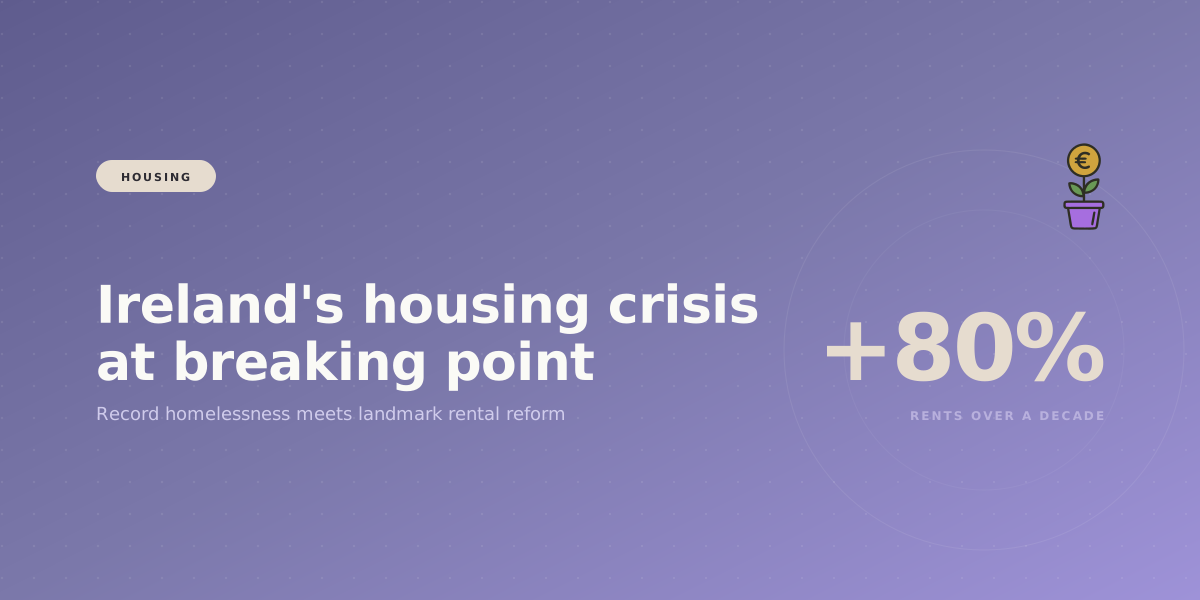
Irish rents have risen 80% in the last decade. Over the same period, wages rose just 27%. That gap isn't closing. It's widening every year.
As of February 2026, the national average rent for a two-bedroom apartment hit €2,086 a month. In Dublin, it's €2,696. Galway rents jumped 11.4% in a single year. Cork rose 7.5%. Waterford, 6.9%.
And there's almost nothing to rent even if you could afford it. Just 1,777 homes were available to rent nationally on 1 February 2026, down 22% on the previous year and 47% below the 2015-2019 average. In Dublin, that's 859 homes for a metro area of over 1.4 million people.
Tenants in the greater Dublin area spend an average of 36% of their net income on rent, with 64% exceeding the 30% threshold that housing experts consider the upper limit of affordability. Meanwhile, 17,308 people are homeless, including 5,457 children, a 12.5% increase in one year.
What does this mean for public sector workers?
Let's talk about who actually keeps Dublin running.
A starting staff nurse earns roughly €35,000 to €37,000. A new Garda starts at €38,694. These aren't low-paid jobs. They require years of training and carry significant responsibility. But Dublin's rental market doesn't care about your qualifications.
At €2,696 a month, a Dublin two-bed consumes 84% of a Garda's gross salary and over 90% of a starting nurse's. Even after tax, the picture is grim. Union representatives have warned that members in Dublin, including nurses, midwives, teachers, Gardaí and many more, are paying over 50% of their wages on rent.
The downstream effects are real:
- Teaching: School principals across Dublin reported an acute recruitment crisis, with 134 permanent posts vacant because candidates can't afford to live nearby
- Healthcare: An estimated 35,000 Irish citizens emigrated in the year to April 2025, many of them healthcare workers, with the cost of housing the main reason cited
- Policing: Garda recruitment and retention is under pressure as trainees weigh starting salaries against Dublin's cost of living
As one nurse preparing to relocate abroad put it: "It feels like you can have a career here, but you can't have a life here."
When a nurse leaves, someone waits longer in A&E. When a teacher leaves, a classroom has a higher student count with less time for each child. When a Garda leaves, a community is less safe. This isn't just a housing problem. It's a public services problem.
What does the UK do differently?
Across the Irish Sea, the UK recognised decades ago that you can't ask public sector workers to serve in expensive cities on salaries designed for cheaper ones.
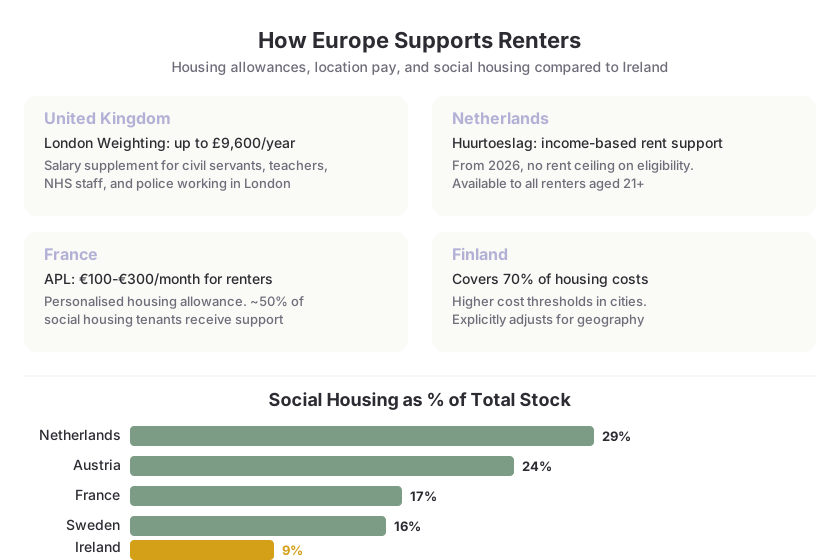
Their solution is called London Weighting: an annual salary supplement paid to civil servants, teachers, NHS staff, and police officers who work in London. NHS staff in inner London receive up to £8,500 extra per year, with teachers receiving up to £5,800. Exact rates vary by department and role, but the principle is consistent: the same job costs more to live near in some places, and pay should reflect that.
Ireland has nothing equivalent. A nurse in Dublin earns the same base salary as a nurse in Donegal, where rent averages €1,036 a month, less than 40% of Dublin rates.
How do other European countries support renters?
The UK's approach is one model, but it's far from the only one. Most of Europe has built housing support systems that Ireland simply doesn't have.
The Netherlands provides huurtoeslag (housing benefit) to renters based on income, rent level, and household size. From January 2026, the Dutch government removed the rent ceiling for eligibility, meaning anyone aged 21 and over can receive rental support regardless of how high their rent is.
France offers APL (Aide Personnalisee au Logement), a personalised housing allowance that provides €100 to €300 a month to renters. About half of all social housing tenants in France receive housing allowances.
Finland's general housing allowance covers up to 70% of housing costs, with maximum limits that vary by municipality, explicitly acknowledging that geography affects affordability.
Denmark provides boligstotte (housing benefit), a monthly subsidy scaled by income, household size, and rent level, available to all renters who meet the criteria.
And then there's Vienna, arguably the gold standard. Roughly 50% of Vienna's population lives in social or subsidised housing. The city has never sold off its municipal housing stock, and the sheer volume of affordable homes exerts a price-dampening effect across the entire market, keeping rents relatively moderate compared to other major cities.
Why doesn't Ireland's safety net work?
Ireland does have a rental support scheme: the Housing Assistance Payment (HAP). On paper, it helps low-income renters bridge the gap between what they can afford and what the market charges. In practice, it has fallen dangerously out of step with reality.
In December 2025, there were zero properties available within standard HAP limits across all 16 areas surveyed by the Simon Communities. Not one. Just 31 properties were available within discretionary HAP rates, representing 3% of all rental listings.
Threshold, the housing charity, found that 74% of tenants receiving rent subsidies were paying extra on top of what the state and they themselves were contributing. The HAP limits haven't kept pace with the market they're supposed to address.
And here's the problem for public sector workers specifically: HAP is means-tested. A Garda or nurse on a full-time salary doesn't qualify. They earn too much for social support but too little for the private market. It's a gap that affects tens of thousands of working people.
Where does Ireland stand on social housing?
This isn't just about subsidies. Ireland has a structural supply problem that no amount of rent support can fully solve.
Social housing makes up just 9% of Ireland's housing stock. For comparison:
- Netherlands: 29%
- Austria: 24%
- France: 17%
- Sweden: 16%
- Ireland: 9%
The Housing Commission estimates an underlying shortage of 212,500 to 256,000 homes based on 2022 census data. Meanwhile, between 102,000 and 164,000 properties sit vacant or derelict across the country.
To be fair, the government has allocated €11.3 billion to housing in Budget 2026, including €2.9 billion for new-build social homes. Dublin City Council has also announced a key worker housing pilot that would convert vacant buildings into cost-rental homes for Gardaí, nurses, and teachers. These are steps in the right direction.
But the pilot covers just two streets, and the first homes won't be available until 2028. The state currently pays private landlords roughly €2 million a day in HAP transfers, with nothing permanent to show for it. Scaling what works and moving faster aren't optional.
What could Ireland actually do?
There's no single fix for a problem this deep. But there are proven models from across Europe that Ireland could adapt, and some of them could make a difference quickly.
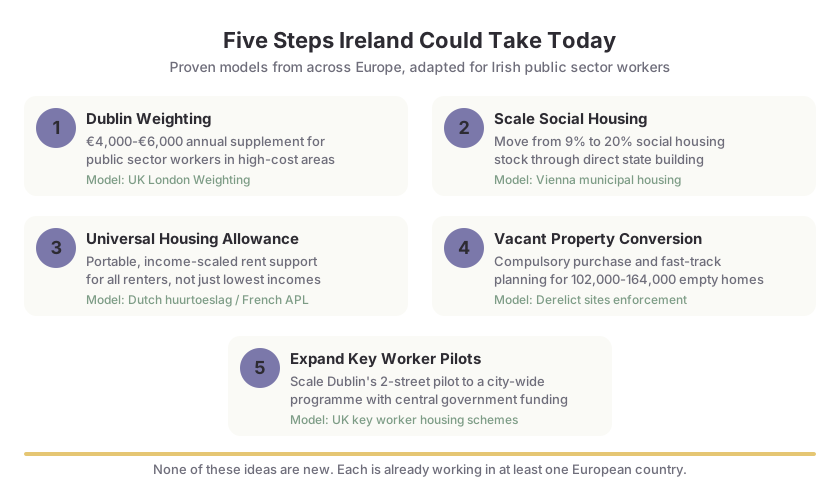
1. A Dublin Weighting for public sector workers. Following the UK's London Weighting model, a salary supplement of €4,000 to €6,000 for public sector workers in Dublin and other high-cost urban areas would be a direct, targeted way to stem the recruitment and retention crisis. It wouldn't solve the housing shortage, but it would acknowledge the reality workers are living with.
2. Building social housing at European scale. Moving from 9% to even 15-20% social housing stock means direct state building, not relying solely on the private sector and HAP transfers. Vienna's model shows that large-scale public housing doesn't just help the people living in it; it puts downward pressure on the entire market.
3. A universal housing allowance. The Dutch, French, and Finnish models all provide portable, income-scaled housing benefits to renters. A similar system in Ireland, available to working people and not just those on the lowest incomes, would immediately reduce the rent burden.
4. Fast-tracking vacant property conversion. With up to 164,000 vacant or derelict homes, unused supply exists. Compulsory purchase orders, streamlined planning, and genuine enforcement of the derelict sites levy could bring thousands of homes back into use within years, not decades.
5. Expanding the key worker housing pilot. Dublin City Council's two-street pilot needs to become a city-wide programme backed by central government funding. Key workers need housing solutions now, not in 2028.
What can you do in the meantime?
Systemic change takes time. While we wait for policy to catch up with reality, there are practical steps you can take to stay on top of your finances:
- Know your numbers. Track what percentage of your income goes to rent. If it's above 30%, you're in the red zone, and budgeting becomes essential, not optional.
- Explore all options. Cost-rental schemes, shared equity, and the Help to Buy incentive are worth investigating even if the criteria feel tight. Citizens Information maintains an up-to-date guide.
- Talk to your union. If you're a public sector worker, your union is actively lobbying on housing. The more members raise the issue, the harder it is to ignore.
- Budget with intent. When rent takes this much of your income, every other euro matters more. Understanding exactly where your money goes is the first step toward making it stretch further.
Cozzy helps you track your spending, build a budget that works for your real life, and plan for the future. If you're feeling the squeeze, we're here to help.