My Future Fund: Should You Stay In or Opt Out This July?
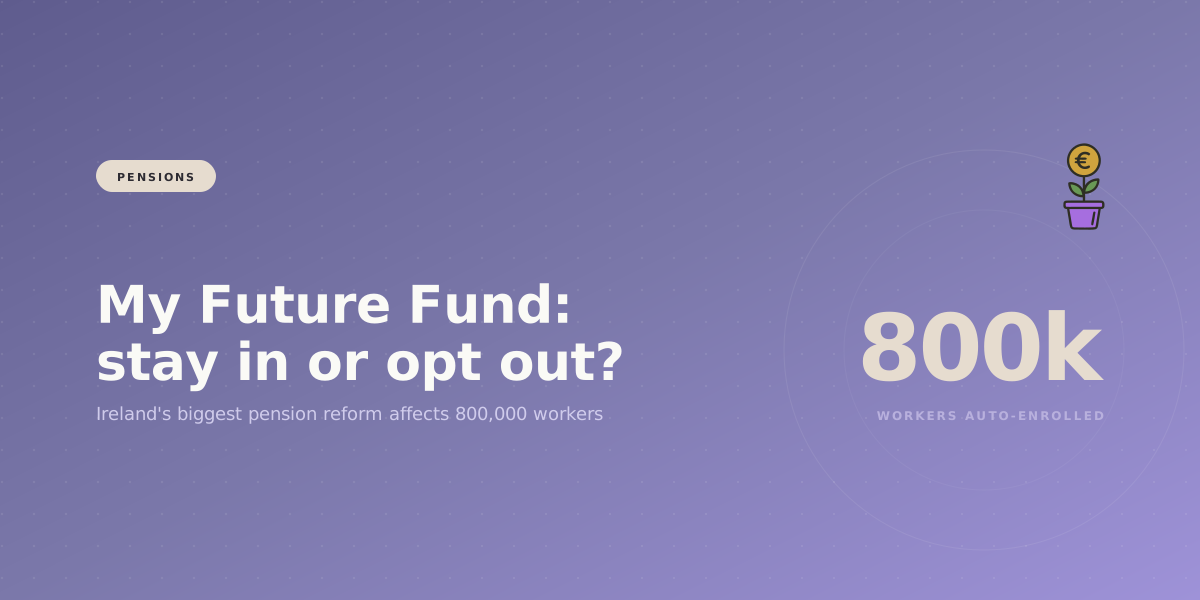
In July 2026, roughly 800,000 Irish workers will face a decision that could shape their retirement: stay enrolled in My Future Fund, or opt out and keep the money in their take home salary.
It is a dilemma. Take-home pay is already squeezed. Rents have passed €2000 a month nationally. And a Bank of Ireland survey found that only 38% of Irish adults could correctly answer basic questions about savings. For many workers, the pension deduction hitting their payslip since January was the first time they'd ever thought about retirement saving.
So let's break down what My Future Fund actually is, what it costs, what you get back, and whether opting out makes financial sense.
What is My Future Fund?
My Future Fund is Ireland's new auto-enrolment pension scheme. It launched on 1 January 2026 after decades of political delay. Administered by the National Automatic Enrolment Retirement Savings Authority (NAERSA), it automatically enrols employees who:
- Are aged 23 to 60
- Earn at least €20,000 per year
- Are not already paying into a workplace pension through payroll
If you tick those boxes, you're in. No forms, no action needed. Your employer deducts contributions from your gross pay automatically.
Ireland had one of the lowest supplementary pension coverage rates in Europe before this. CSO data for Q3 2024 showed just 67% of workers had any pension beyond the State Pension, and for those aged 20-24, coverage was just 27%. When asked why they had no pension, 43% said they "never got around to it". Auto-enrolment fixes that inertia problem by making saving the default.
What does it cost you?
Right now, not much. Here's how contributions phase in over the next decade:
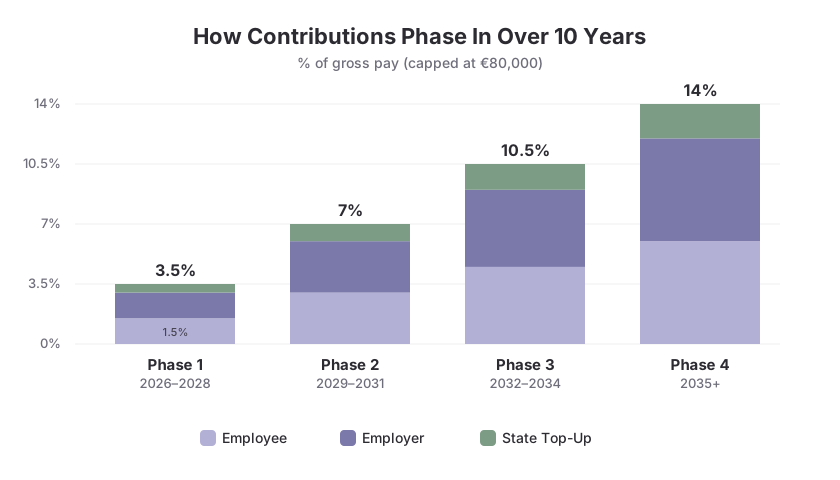
In Phase 1 (2026 to 2028), you contribute 1.5% of your gross pay. Your employer matches that at 1.5%, and the State adds 0.5%. That's a total of 3.5% going into your pension pot, but only 1.5% comes from your pocket.
For someone earning €35,000, that means roughly €525 per year, about €10 per week off your take-home pay.
By the 10th year, 2035 onwards, contributions reach 6% employee, 6% employer, and 2% State, totalling 14% of gross pay, capped at earnings of €80,000.
Your four investment choices
Your money goes into one of four funds:
- Conservative: bonds and cash (lower risk, lower return)
- Moderate: a mix of bonds, equities, and indices
- Higher Risk: equities and property (higher growth potential, higher risk)
- Lifecycle Default: starts aggressive, automatically shifts to lower risk as you approach retirement
If you haven't actively selected a fund, you're placed in the Lifecycle Default. For most people, that's a pretty good option.
The free money maths
This is the part that makes auto-enrolment hard to walk away from.
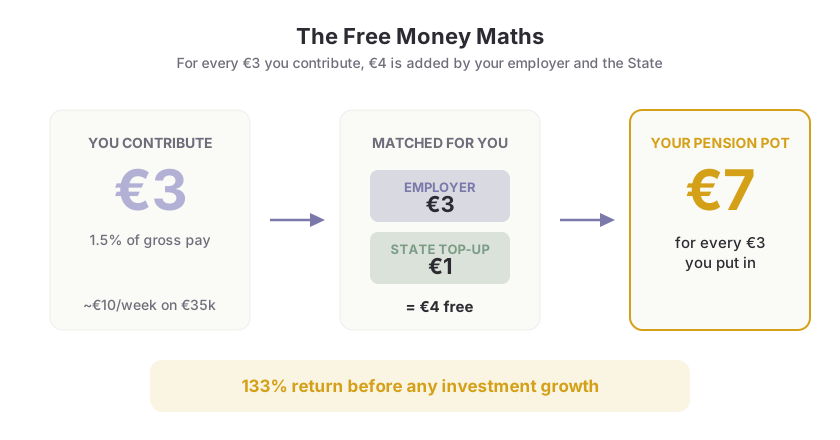
For every €3 you put in, your employer adds €3 and the State adds €1. That's €4 in matched contributions for every €3 of your own money, a 133% return before a single cent of investment growth.
No savings account, no investment product, and no side hustle offers anything close to that return. It's effectively free money, and opting out means leaving it on the table.
The opt-out window: how it works
You can't opt out immediately. The first opt-out window opens in July 2026, six months after enrolment. You'll have a two-month window (months 7 and 8) to make your decision.
If you opt out:
- Your employee contributions are refunded to you
- Employer and State contributions remain in your pot. They can't be refunded as cash, but the money is still yours if you re-enrol or reach retirement.
- You'll be automatically re-enrolled after two years, and you'll need to opt out again if you still want out
- Every time contribution rates increase (2029, 2032, 2035), you'll get another opt-out window
This design is deliberate. The UK introduced auto-enrolment in 2012 and found that opt-out rates settled at just 8.3%, far lower than expected. Most people, once enrolled, stay enrolled. The inertia that stopped people saving now works in their favour.
The case for staying in
The State Pension isn't enough on its own. The maximum contributory State Pension is €299.30 per week, about €15,600 per year. For an average earner, that replaces roughly a third of pre-retirement income according to OECD data. Unless you have other savings, retirement means a sharp drop in living standards.
Starting young matters enormously. A 25-year-old contributing 1.5% of a €30,000 salary today, with contributions scaling to 6% by 2035, builds a meaningful pension pot over 40 years of compound growth. Someone who opts out for a decade and starts at 35 faces the same maths with ten fewer years.
You don't lose control. You choose your investment fund, you can track your pot online through the My Future Fund portal, and your money is held separately from any employer scheme.
The case for opting out (and why it's usually weak)
The most common reason people consider opting out is cash-flow pressure. Inflation is at 2.6%, rents keep rising, and the CCPC reports that 1 in 8 Irish adults could only cover expenses for a month or less if their income stopped.
Let's consider the numbers. At a €35,000 salary, Phase 1 contributions cost you €10 per week. In return, your employer and the State add another €14 per week to your pension. Opting out to save €10 a week means forfeiting €14 a week in matched contributions.
There are a few situations where opting out might genuinely make sense:
- You're drowning in high-interest debt (credit card, overdraft) and every euro counts toward clearing it
- You already contribute the maximum to a PRSA or occupational pension and the additional auto-enrolment pushes you past tax relief limits
- You're within a few years of retirement and the short time horizon limits growth
For most people under 55 who don't have a workplace pension, staying in is probably the right move.
Ireland's financial literacy gap
Part of what makes this decision hard is that pension conversations don't come naturally. The Bank of Ireland Financial Literacy Index gave Irish adults an average score of just 54%. Only 27% recalled learning about money in school. And only 57% of adults meet the minimum financial literacy threshold set by the OECD.
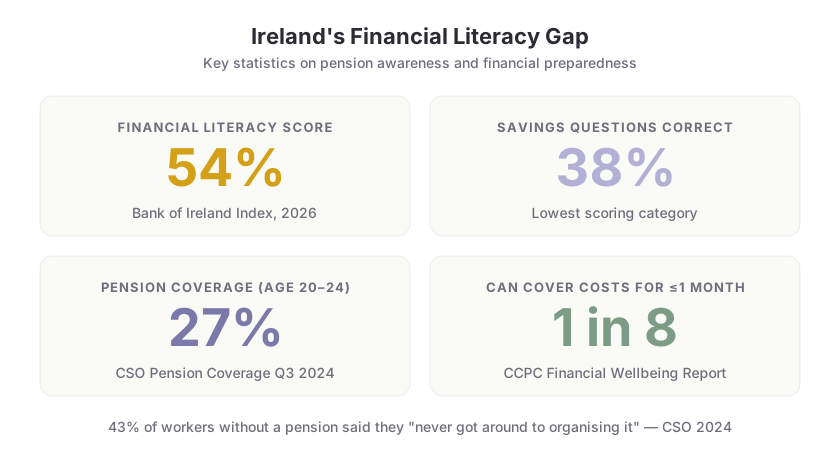
The government has recognised this. Ireland published its first National Financial Literacy Strategy in February 2025, and the CCPC has committed €200,000 to adult financial literacy programmes in 2026.
But literacy campaigns take years to shift the dial. Auto-enrolment doesn't wait for you to understand compound interest. It just starts saving for you. That's the whole point.
What to do before July
-
Check your payslip. You should see My Future Fund deductions since January. If you don't and think you should be enrolled, contact your employer or NAERSA.
-
Choose your fund. If you haven't actively selected an investment fund, you're in the Lifecycle Default. That's fine for most people, but review the options if you have a strong preference.
-
Do the maths on opting out. Calculate what you contribute per week versus what your employer and the State add. For most people, the answer is clear.
-
If you already have a PRSA, you don't have to choose between them. You can stay in both and adjust your PRSA payments if cash is tight.
-
Talk to someone. If you're unsure, the CCPC's money tools are free, and a qualified financial advisor can review your specific situation.
The opt-out window opens in July and closes two months later. If you do nothing, you stay enrolled. Considering benefits, it's probably the right call.
Cozzy helps you see what your auto-enrolment deduction means for your monthly budget, alongside everything else you're juggling. Try it free at cozzy.io.